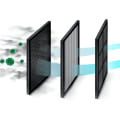
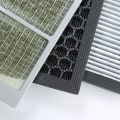
Here's something most filter shoppers never consider: the size of your air filter is doing more for your energy bill than you probably realize.
After manufacturing millions of filters and fielding conversations with homeowners across Florida — where HVAC systems run virtually every month of the year — we've learned that filter depth is one of the most underestimated efficiency variables in any home. Not MERV rating. Not a brand. Depth.
A standard 1-inch filter loads up fast. When it does, airflow tightens. Your system compensates. Run times stretch. Costs climb. What we've consistently seen is that homeowners switching to a 12x26x4 air filter — that full 4-inch media bed — are giving their HVAC room to breathe in a way thin filters simply can't provide.
More media means:
More contaminant capacity before restriction builds
Lower sustained pressure drop over the filter's service life
Fewer demand spikes on your system between change intervals
That's not a marketing claim. That's what the physics of airflow and filtration surface area actually produce — and what we've observed playing out in real homes over time.
This page breaks down exactly how 12x26x4 air filters support energy-efficient homes, which MERV ratings deliver the right balance of filtration and airflow for Florida's conditions, and how to make the most of every filter you install.
TL;DR Quick Answers
12x26x4 Air Filters
A 12x26x4 air filter is a 4-inch deep, high-capacity HVAC filter designed for whole-home air handlers and dedicated media cabinet housings. It is not compatible with standard 1-inch filter slots.
What makes the 12x26x4 different:
4-inch media bed captures more contaminants before airflow restriction builds
Larger filtration surface area maintains lower pressure drop over a longer service life
Reduces the strain on your HVAC system that drives up energy costs
Best MERV ratings for the 12x26x4 format:
MERV 8 — basic protection, lowest restriction
MERV 11 — best balance of filtration and airflow for most homes
MERV 13 — recommended for allergy and asthma households
Typical change interval: 6 to 12 months, depending on pets, allergies, and local air quality conditions.
Why it matters in Florida: Year-round HVAC operation loads filters faster. The 12x26x4's expanded media capacity is built for climates with no real off-season — sustaining efficiency longer between changes than any 1-inch filter can.
Bottom line: The right 12x26x4 filter, matched to the correct MERV rating and changed on schedule, protects your family's air, reduces energy consumption, and extends the life of your HVAC system.
Top Takeaways
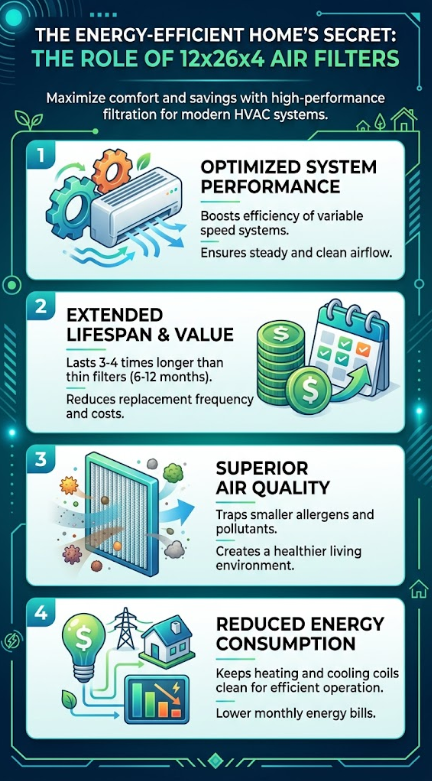
Filter depth drives efficiency. The 4-inch media bed sustains lower pressure drop longer — so your HVAC runs less, costs less, and lasts longer.
MERV rating alone doesn't tell the full story. Depth distributes filtration density across more surface area. You get better air quality without the airflow penalty.
Your filter sits at the center of your home's largest energy draw. Heating and cooling consume nearly half of average home energy use. A properly matched 12x26x4 is one of the most overlooked efficiency decisions you can make.
Florida's climate demands more from every filter change. Sealed homes, year-round HVAC operation, and high humidity create a continuous particulate load thin filters can't sustain. The 12x26x4 is built for exactly this.
Consistency beats perfection. The right filter, changed on schedule, every time — that's what actually protects your family, your home, and your HVAC system.
Why Filter Depth Is an Energy Efficiency Variable Most Homeowners Ignore
The conversation around home energy efficiency usually centers on insulation, windows, and smart thermostats. Rarely does it land on air filter depth — and that's a gap we've watched cost homeowners real money over time.
A 4-inch filter like the 12x26x4 isn't just a thicker version of a 1-inch filter. It operates on fundamentally different physics. More media depth means a larger filtration surface area. Larger surface area means air passes through with less resistance. Less resistance means your HVAC system doesn't have to strain to move conditioned air through your home.
In our experience, that distinction matters most in Florida — where systems run 10 to 12 months a year. Every hour of reduced strain compounds into meaningful efficiency gains across an entire cooling season.
The Pressure Drop Problem No One Talks About
Every air filter creates resistance — engineers call it pressure drop. A clean filter produces minimal resistance. A loaded filter produces significantly more.
With a 1-inch filter, that loading happens fast. Dust, pollen, pet dander, and humidity-fed particulates pack the thin media within weeks. Pressure builds. Your blower motor works harder. Run times extend.
The 12x26x4 format delays that curve substantially. Its expanded media holds far more contaminants before restriction builds — keeping pressure drop low across a much longer service window. That's not a feature. That's physics working in your favor.
How the Right MERV Rating Protects Both Air Quality and System Efficiency
After manufacturing millions of filters, we've seen one mistake repeat itself constantly: homeowners choosing the highest MERV rating available, assuming more filtration always means better performance. It doesn't — not without the right filter depth to support it.
Higher MERV ratings use denser media to capture smaller particles. That density increases airflow resistance. In a 1-inch filter, a MERV 13 can actually choke airflow enough to reduce system efficiency and accelerate wear. In a 12x26x4, the deeper media bed distributes that density across a much larger surface — so you get the filtration benefit without the airflow penalty.
For most Florida homes running standard residential HVAC equipment, here's what we consistently recommend:
MERV 8 — solid baseline filtration, lowest airflow restriction, best for older systems or homes without allergy concerns
MERV 11 — the sweet spot for most households; captures fine dust, mold spores, and pet dander without meaningfully impacting airflow
MERV 13 — appropriate for homes with allergy or asthma concerns; well-suited to 4-inch filters where the media bed can handle the added density
The goal is effective filtration that doesn't fight your system. In a 12x26x4, you have the depth to make that balance achievable.
Extended Change Intervals — And Why They Actually Support Efficiency
One of the practical advantages of a 12x26x4 filter that rarely gets discussed is its change interval. A properly matched 4-inch filter in a typical Florida home can last 6 to 12 months between changes — compared to 1 to 3 months for a standard 1-inch filter.
That matters for efficiency in two ways most homeowners don't consider.
First, a filter that gets changed too infrequently on a 1-inch media clogs and restricts airflow — adding system strain during exactly the months your HVAC is working hardest. A 4-inch filter's larger capacity means it reaches that restriction point far later in its service life.
Second, consistent filter replacement is something we've found homeowners are more likely to maintain when the interval is longer and easier to remember. A filter that gets changed on schedule performs better than one that gets changed in a panic after the system starts struggling.
The 12x26x4 format supports both the physics and the habits of an energy-efficient home.
What Florida's Year-Round HVAC Climate Reveals About Filter Performance
Most filter guidance is written for homes with true off-seasons — where the HVAC sits idle for months and filter loading slows naturally. Florida doesn't work that way.
In Central Florida, air handlers run nearly year-round. That continuous operation means filters load faster, pressure drop builds more quickly, and the efficiency cost of a restrictive or neglected filter is amplified. We've consistently observed that homeowners in sealed, humidity-managed Florida homes see more pronounced efficiency losses from thin or overloaded filters than counterparts in cooler climates.
The 12x26x4's capacity advantage is especially relevant here. Its larger media surface distributes the contaminant load that accumulates during year-round operation — sustaining lower pressure drop across the full service interval in a way a 1-inch filter simply cannot.
If your system runs 10 or more months a year, filter depth isn't a nice-to-have. It's a practical efficiency decision.
Signs Your Current Filter May Be Costing You on Energy
You won't always notice a struggling filter from the outside. But your system will show the signs if you know where to look:
Rising energy bills without a change in usage or thermostat settings
Longer run cycles — the system runs but the home takes longer to reach set temperature
Reduced airflow from supply vents, even with a clean-looking filter surface
Increased dust accumulation on surfaces shortly after filter changes
More frequent system cycling or unexpected shutdowns
Each of these points back to restricted airflow — the core problem an undersized or overloaded filter creates. Switching to a properly matched 12x26x4 filter at the right MERV rating resolves the restriction at its source, giving your system the airflow it was designed to operate with.

"After manufacturing millions of filters and watching how they perform in real Florida homes, the pattern is clear: homeowners who switch to a quality 4-inch filter almost always tell us their system feels like it's running easier — and their energy bills reflect it. Filter depth isn't a premium upgrade. In a climate where your HVAC never really gets a break, it's one of the smartest efficiency decisions you can make."
Essential Resources: What Every Homeowner Should Know Before Choosing a 12x26x4 Air Filter
Don't take your indoor air for granted. After manufacturing millions of filters and working with homeowners across the country, we've learned that the most confident filter decisions come from understanding the science behind the slot — not just the size on the label. We've pulled together the seven most valuable authoritative resources on filtration, MERV ratings, energy efficiency, and indoor air quality so you can protect your family with the same knowledge we rely on every day.
1. The EPA's Guide to What Your HVAC Filter Is Actually Doing
U.S. Environmental Protection Agency — Air Cleaners and Air Filters in the Home Most homeowners think of an air filter as a dust trap. The EPA's consumer guide reveals what's really at stake — from the invisible pollutants cycling through your home to how MERV ratings translate to real-world filtration performance. We point every customer here first.
URL: https://www.epa.gov/indoor-air-quality-iaq/air-cleaners-and-air-filters-home
2. Why Florida Homes Demand More From Every Filter Change
U.S. Department of Energy — Efficient Cooling for Hot, Humid Climates In our experience working with Florida homeowners, the year-round HVAC demands of a hot, humid climate change the entire filtration equation. The DOE breaks down exactly how airflow, filter maintenance, and system efficiency interact in climates like ours — and why what works up north won't cut it here.
URL: https://www.energy.gov/energysaver/efficient-cooling-hot-humid-climates
3. The Real Cost of Ignoring Your Filter — Straight From ENERGY STAR
ENERGY STAR — Heat & Cool Efficiently We've seen it consistently: a neglected filter quietly drains efficiency month after month. ENERGY STAR puts hard numbers behind what we tell customers every day — a dirty filter forces your system to work harder, run longer, and cost you more. This resource makes the invisible cost visible.
URL: https://www.energystar.gov/saveathome/heating-cooling
4. MERV Ratings Explained by the Organization That Created Them
ASHRAE — Filtration and Disinfection FAQ We rely on ASHRAE standards in everything we manufacture. Their filtration FAQ cuts through the confusion around MERV ratings — explaining what each level actually captures, how filter density affects your system's airflow, and what performance levels make sense for a residential home like yours.
URL: https://www.ashrae.org/technical-resources/filtration-and-disinfection-faq
5. How Filter Depth and Proper Installation Protect Your System
U.S. Department of Energy — HVAC Proper Installation of Filters Here's something we've observed time and again: the right filter in the wrong setup still underperforms. The DOE's technical resource explains how filter depth, MERV rating, and correct installation work together — and what happens to your blower motor and energy consumption when any one of those factors is off.
URL: https://bsesc.energy.gov/energy-basics/hvac-proper-installation-filters
6. The Health Stakes Behind Every Filter You Install
National Institute of Environmental Health Sciences — Indoor Air Quality We're obsessed with clean air because we know what poor air quality actually does to the people breathing it. NIEHS research documents the measurable health impacts of indoor particulate matter, mold spores, and allergens — and gives every homeowner a clear picture of why their filter choice is a family health decision, not just a maintenance task.
URL: https://www.niehs.nih.gov/health/topics/agents/indoor-air
7. What the CDC Says About the Particles Your Filter Is Defending Against
Centers for Disease Control and Prevention — Air Pollutants Protecting your greatest assets — your family, your home, your HVAC system — starts with understanding what you're up against. The CDC's overview of PM2.5 and PM10 particulate matter explains why these invisible particles matter for respiratory and cardiovascular health, and why effective filtration is one of the most practical defenses you have inside your own home.
URL: https://www.cdc.gov/air-quality/pollutants/index.html
Supporting Statistics
Routinely replacing or cleaning air filters can lower an air conditioner's energy consumption by 5 to 15 percent.
(U.S. Department of Energy) https://www.energy.gov/energysaver/articles/energy-saver-101-home-cooling-infographic
The bottom of that range matters as much as the top. Here's why:
A 5% efficiency gain compounds fast in a climate where systems run 10+ months a year
Homes on consistent filter change schedules report lower bills and fewer service calls — we've seen this pattern across more than a decade of customer conversations
The 12x26x4 media bed extends peak-efficiency performance longer between changes
Result: fewer intervals where a loaded filter quietly drains your system before you notice
Nearly half of the energy used in the average home goes to heating and cooling.
(ENERGY STAR — Heat & Cool Efficiently) https://www.energystar.gov/saveathome/heating-cooling
Most homeowners chasing lower energy costs focus on thermostats, windows, and insulation. After manufacturing millions of filters, here's what we've learned they're missing:
Your air filter sits at the center of your home's single largest energy draw
A filter maintaining low pressure drop lets your system run as engineered
A filter that loads fast and restricts airflow forces your system to compensate
That compensation shows up on your bill every month — invisibly, before most homeowners connect cause to cost
Americans spend approximately 90% of their time indoors, where concentrations of some pollutants are often 2 to 5 times higher than typical outdoor concentrations.
(U.S. Environmental Protection Agency — Indoor Air Quality Report on the Environment) https://www.epa.gov/report-environment/indoor-air-quality
This is the statistic that reframes what a filter actually does. It's not a maintenance task. It's a daily health decision. Consider what that means in practice:
Your family breathes indoor air during 90% of their daily lives
Florida's sealed, humidity-managed homes recirculate that same air year-round
Closed windows and continuous HVAC operation mean particulate loads build without relief
The 12x26x4's expanded media gives your home's air a sustained, active defense — not just a longer change interval
Final Thoughts
After manufacturing millions of filters and watching how they perform across real homes in real climates, here's our honest take: the 12x26x4 is one of the most underutilized efficiency tools available to a homeowner — and most people who need one don't fully understand why until they've made the switch.
The filter depth conversation almost never comes up when homeowners are shopping. They focus on MERV rating, brand, and price. Depth — the variable that most directly determines how long a filter sustains low pressure drop before restricting airflow — rarely enters the discussion. That gap is something we've been working to close for years.
Our position, shaped by what we've consistently observed:
In Florida's climate, the 12x26x4 isn't a premium upgrade. It's the practical baseline.
Here's why we hold that firmly:
Year-round HVAC operation loads a 1-inch filter faster than most homeowners expect
Once loaded, airflow restricts — and efficiency losses compound silently across months of continuous use
The 4-inch media bed changes that dynamic: more capacity, lower sustained pressure drop, longer intervals before restriction builds
The result isn't just cleaner air — it's a system running closer to its designed efficiency for significantly longer between changes
There's one more thing most filter guidance doesn't address directly.
Filter depth and change interval are connected. A homeowner on a 6-to-12-month 12x26x4 schedule is far more likely to stay consistent than one trying to remember a 30-day 1-inch swap. And a filter changed on schedule — every time — outperforms a theoretically better filter that gets neglected.
Protecting your family, your home, and your HVAC system doesn't have to be complicated. The homeowners who get the most from their filtration decisions do three things:
Understand the physics behind the filter slot
Match the filter to the climate they actually live in
Stay consistent with their change schedule
The 12x26x4 makes it easier to get all three right.
FAQ on “12x26x4 Air Filters”
Q: What does the 12x26x4 size mean, and how do I know if it's the right filter for my HVAC system?
A: The three numbers are the filter's nominal dimensions — 12 inches tall, 26 inches wide, 4 inches deep. The depth is the decision. The 12 and 26 identify the slot. The 4 changes how your entire system performs.
The 12x26x4 is built for HVAC systems with a wider filter cabinet — whole-home air handlers and dedicated media cabinet housings. It is not interchangeable with a standard 1-inch slot.
To confirm compatibility before ordering:
Check the dimensions printed on your current filter
Measure the filter slot opening directly
Cross-reference your HVAC manufacturer's equipment specs
Already running a 12x26x4? You're in the right place. Upgrading from a 1-inch filter? Start with a qualified HVAC technician — not a filter swap.
Q: What MERV rating should I choose for a 12x26x4 air filter?
A: The MERV conversation changes completely with a 4-inch filter. A MERV 13 in a 1-inch format can choke system airflow. That same MERV 13 in a 12x26x4 distributes across enough surface area to handle the resistance — without the performance penalty. The format unlocks ratings the 1-inch slot simply can't support.
For most Florida homeowners, here's what we recommend:
MERV 8 — Baseline protection. Best for older systems or homes without allergy concerns. Lowest restriction.
MERV 11 — The sweet spot for most households. Captures fine dust, pet dander, pollen, and mold spores. Our starting recommendation for most Central Florida homes.
MERV 13 — Right for households with allergy or asthma sensitivities. The 12x26x4 format handles this rating well.
Use the highest MERV your system supports. In a 4-inch filter, that ceiling is considerably higher than most homeowners assume.
Q: How often should I replace a 12x26x4 air filter?
A: In most Florida homes running HVAC year-round: 6 to 12 months. That's considerably longer than the 1-to-3-month window for standard 1-inch filters.
These factors push you toward the shorter end of that range:
Pets in the home, especially heavy shedders
Residents with allergies or respiratory sensitivities
Active construction or renovation nearby
Higher-than-average household dust load
Our practical rule:
Check the filter visually at 6 months
Heavy grey loading across the media surface — change it
Still relatively clean — it can typically run the full 12 months
Never let the longer interval become an excuse to forget — a filter at month 14 is working against you
Q: Is a 12x26x4 air filter better than a standard 1-inch filter for energy efficiency?
A: In Florida's climate — consistently yes. Here's why:
A 1-inch filter loads quickly. As it does:
Airflow resistance builds
Your blower motor compensates
Run cycles extend
Energy consumption climbs — quietly, before most homeowners notice
The 12x26x4 changes that equation at the source:
Its media bed distributes contaminant load across a much larger surface area
Pressure drop stays lower across a longer service window
Your system moves conditioned air the way it was engineered to
The numbers back it up. The U.S. Department of Energy confirms that routinely replacing air filters can reduce an air conditioner's energy consumption by 5 to 15 percent. In a climate where systems run 10 or more months a year, that's a real efficiency dividend — compounding across every billing cycle.
Q: Can I use a 12x26x4 air filter in any HVAC system?
A: No. This is one of the most important compatibility questions to get right before purchasing.
What you need to know:
A 12x26x4 requires a filter slot or media cabinet built specifically for 4-inch depth filters
Standard residential systems ship from the factory with a 1-inch slot
The two are not interchangeable
Forcing a 4-inch filter into a 1-inch opening creates air bypass gaps — unfiltered air routes directly into your system and blower motor
If you're currently on a 1-inch filter and want to upgrade:
Contact a qualified HVAC technician
Ask about a media cabinet retrofit for your system
Confirm compatibility before purchasing any 4-inch air filter
Homeowners who make that upgrade — and pair it with the right size and MERV rating — consistently report better air quality, lower energy costs, and a change schedule they can actually maintain. The 12x26x4 is a better filter. But it has to be the right filter for your system first.
Your Home's Energy Efficiency Starts With the Right 12x26x4 Air Filter
We've spent over a decade manufacturing filters built to protect your family, your home, and your HVAC system — shop our 12x26x4 air filters today and experience the difference the right filter makes on your air quality, your energy bill, and your peace of mind.
Learn more about HVAC Care from one of our HVAC solutions branches…
Filterbuy HVAC Solutions - West Palm Beach FL
1655 Palm Beach Lakes Blvd., Ste 1005 West Palm Beach, FL 33401
(561) 448-3760
https://maps.app.goo.gl/VarpgNZnxuPQuW8A7